rosawyer
 Morattico Baptist Church sits nestled on a sloping field near Route 200 in Lancaster County, Virginia. Even though it may seem unassuming, its roots date back to January 17, 1778. Through history and shared stories, we can connect the birth, growth, and expansion of the Baptist faith of the Mother Baptist Church of the Northern Neck. Through it all, the Morattico Baptist Church remains a steadfast reminder of the strength, faith, and love of the Northern Neck community.
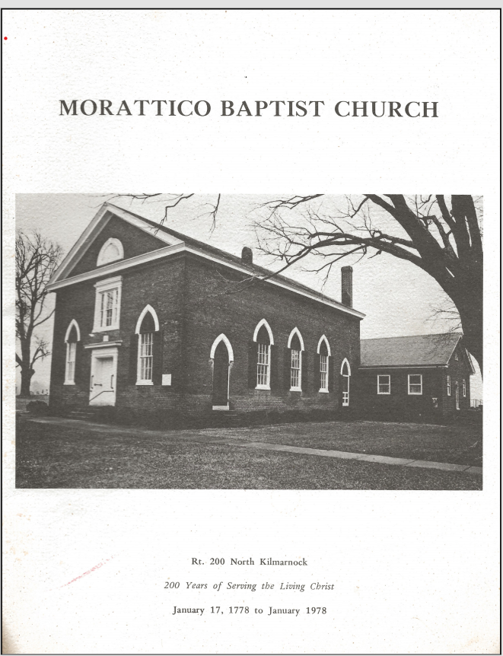
Birth of the Morattico Church and Reasons to Break from the Church of England.
Morattico Baptist Church was born during the American Revolution. In Virginia, the Anglican Church was established by law, and dissenters, if they existed, were considered second-class citizens. Very few churches of other denominations existed in the Northern Neck during this period because Anglicanism was enshrined as the colony’s official religion. Tax collection and mandatory church attendance were required in the Anglican parishes. Dissenters faced fines or social exclusion.
| Learning Box – Church of England |
| Anglican or Episcopalian – This is one in the same, the National Church for the country of England, Great Britain and the United Kingdom. This Religious Institution was pivotal in the Protestant Movement, branching from the Catholic Church. But Anglicanism was never the only church in that homeland: Presbyterian, Methodist and Baptist all evolved from this Orthodoxy. |
The Baptists and Presbyterians were considered dissenters and often fined for holding meetings. Two such Virginians were Alexander Hunton and Lewis Lundsford from Stafford County. From his first introduction to Lunsford, a young Baptist revivalist, Hunton was convinced that he was the man whom God had called to begin the first Baptist Church in the Northern Neck. First chartered at Morattico Hall, the residence of Alexander Hunton in Richmond County, the church began with 16 adult and 2 child members.
The Revolutionary War accelerated the challenges to the Anglican Church in the Commonwealth of Virginia, and Thomas Jefferson’s Statute for Religious Freedom formally ended the connection with the Church of England in 1786. Virginians moved on from the Revolution, and Northern Neck residents began to change in how and where they worshipped. Many dissented from the Anglican Church of England and attended services organized by the evangelical visits from traveling Presbyterians, Methodists, and Baptists. The Baptist preachers were affiliated with Baptist associations from the North, called “Regular” Baptists, or with counties south of the Rappahannock, called “Separate” Baptists. While the Separatists were more enthusiastic and revivalistic than the Regulars, the differences between the two Baptist affiliations were minimal until the Civil War. During that time, many Christian ministers had opposing views on slavery. Despite these differences, the two groups strived to be cooperative.
| Learning Box – Baptist 101 |
| Baptists form a major branch of Protestantism distinguished by baptizing professing believers only (believer’s baptism, as opposed to infant baptism), and doing so by complete immersion (as opposed to affusion or aspersion). Baptist churches also generally subscribe to the doctrines of soul competency (the responsibility and accountability of every person before God), sola fide (salvation by faith alone), sola scriptura (scripture alone as the rule of faith and practice) and congregationalist church government. Baptists generally recognize two ordinances: baptism and communion. Diverse from their beginning, those identifying as Baptists today differ widely from one another in what they believe, how they worship, their attitudes toward other Christians, and their understanding of what is important in Christian discipleship. Source: Wikipedia retrieved July 28, 2020 from: https://en.wikipedia.org/wiki/Baptists#cite_note-Shurden_turning-1 |
The Baptist Evangelist and the Church Builder: Lewis Lundsford and Robert G. Carter
The church’s initial growth is largely attributed to the support of Robert Carter, III, of Nomini Hall in Westmoreland County. Carter, who served as a colonel during the Revolution, was the wealthiest and one of the most influential leaders in Virginia. Colonel Carter followed deism until he heard the sermons of the traveling evangelist, Lewis Lundsford. He wanted to learn more about the revivalist movement and joined the Baptists in 1778. He became the 61st member of Morattico Church and was baptized in the presence of 400 witnesses in Totuskey Creek. Lunsford’s relationship with Carter and other church members led to the construction of the first church building on the current property. Carter offered to provide materials and labor to build a meetinghouse. The two-story Kilmarnock Meetinghouse was built in 1781. Robert Carter is known for his generosity during a period of scarcity following the Revolution, large views of truth, diligence in Bible study, and participation in inter-congregational life. Upon his acceptance into the Morattico Church, the social status of Baptists rose, and subsequently the congregation began to grow. As time passed, “Colonel Carter became a zealous builder of churches and a beneficent church leader” in the Baptist community.
| Learning Box – Lewis Lunsford |
| Lewis Lunsford (1753–1793) was a distinguished and popular 18th-century Baptist minister in Virginia known for his exceptional oratorical skills. Born in Stafford County, Virginia, into poverty, he began preaching in his teens and earned the moniker “the wonderful boy” for his powerful sermons despite lacking a formal education. He served as the first pastor of the Morattico Baptist Church from 1778 until his death, helping establish numerous Baptist churches throughout Virginia’s Northern Neck, and faced arrest and persecution by religious authorities for his preaching during the colonial and Revolutionary periods. Sources: [1] https://www.pbpress.org [2] https://baptisthistoryhomepage.com |
As the Morattico Church grew, ministerial and lay leaders tended to doctrinal and organizational matters throughout the Northern Neck. As such, three districts were formed, and three meetinghouses were constructed with supervising deacons in each district. Until 1793, Lunsford preached at four different meeting places each month, ministering with an effort “to serve the whole man through the community of faith.” He set a standard of ministerial quality that many of today’s Baptist ministers in the Northern Neck continue to uphold.
According to other published stories, Robert Carter continued to focus on the care of his enslaved people, creating a healthier and more hospitable place for them, and improving the conditions on his plantations. “Dissatisfied with the institution of slavery and his role in it, Carter laid out a plan for manumission for the people he enslaved,” in his Deed of Gift recorded in the Northumberland County Courthouse in 1781. Known as the “Great Emancipator,” Carter eventually took different groups of enslaved people to the courthouse and released them from bondage. He then leased land to the people he freed, and by 1797, some of his plantations were completely occupied by formerly enslaved people.
The Expansion of Baptist Churches in the Northern Neck
By the early 1900s, the Morattico Baptist Church gave rise to the expansion of an additional 26 churches. Each was organized under the key principles of Baptist Mission work of evangelism, education, medical and community service, and self-governance. Today, these churches continue to reflect the Baptist congregational polity of preaching the gospel to unreachable people, training missionaries and local leaders, improving health and living conditions to support mission work, and remaining independent.
| Learning Box – First Baptist vs Southern Baptist vs Black Churches |
| Leading up to the American Civil War [(1861 – 1865)], Baptists became embroiled in the controversy over slavery in the United States. Whereas in the First Great Awakening Methodist and Baptist preachers had opposed slavery and urged manumission, over the decades they made more of an accommodation with the institution. They worked with slaveholders in the South to urge a paternalistic institution. Both denominations made direct appeals to slaves and free blacks for conversion. The Baptists particularly allowed them active roles in congregations. By the mid-19th century, northern Baptists tended to oppose slavery. As tensions increased, in 1844 the Home Mission Society refused to appoint a slaveholder as a missionary who had been proposed by Georgia. It noted that missionaries could not take servants with them, and also that the board did not want to appear to condone slavery. The Southern Baptist Convention was formed by nine state conventions in 1845. They believed that the Bible sanctions slavery and that it was acceptable for Christians to own slaves. They believed slavery was a human institution which Baptist teaching could make less harsh. By this time many planters were part of Baptist congregations, and some of the denomination’s prominent preachers, such as the Rev. Basil Manly, Sr., president of the University of Alabama, were also planters who owned slaves. 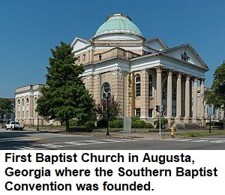 As early as the late 18th century, black Baptists began to organize separate churches, associations and mission agencies. Blacks set up some independent Baptist congregations in the South before the American Civil War. White Baptist associations maintained some oversight of these churches. In the post-Civil War years, Freedmen quickly left the white congregations and associations, setting up their own churches. In 1866 the Consolidated American Baptist Convention, formed from black Baptists of the South and West, helped southern associations set up black state conventions, which they did in Alabama, Arkansas, Virginia, North Carolina, and Kentucky. In 1880 black state conventions united in the national Foreign Mission Convention, to support black Baptist missionary work. Two other national black conventions were formed, and in 1895 they united as the National Baptist Convention. This organization later went through its own changes, spinning off other conventions. It is the largest black religious organization and the second-largest Baptist organization in the world. Baptists are numerically most dominant in the Southeast. In 2007, the Pew Research Center‘s Religious Landscape Survey found that 45% of all African Americans identify with Baptist denominations, with the vast majority of those being within the historically black tradition. |
A distinction that led to the formation of daughter churches in the beginning may have been driven by “the stated values of the American Revolution” that “if all men were created equal, then no man could enslave another.” This supposition led Robert Carter to build Yeocomico Church on one of his plantations near what is now called Mundy Point. He continued to pursue an egalitarian vision of Christianity.
Throughout this period, Morattico and its daughter churches included black and white parishioners. As acknowledged earlier, some daughter churches were built on or near plantations, enabling free and enslaved blacks to worship in the same churches. “In 1840, just before the formation of Lebanon Baptist Church, Morattico had 623 members; 319 were white and 304 coloured.” As Morattico grew, white and black members sought approval to form churches in their respective communities. Early daughter churches were primarily formed by congregants who wanted to have their own public houses of worship where they could meet regularly. Among these newly formed churches were the Coan Baptist Church (formerly established as Wicomico Baptist Church), White Stone Baptist Church, Fairfields Baptist Church, and Lebanon Baptist Church. The first daughter churches established for black congregants include Old Saint John’s Baptist Church (1866), First Baptist Church (1866), Macedonia Baptist Church (1881), Mount Olive Baptist Church (1873), and Zion Baptist Church (1867). Statistics from the minutes of the 10th annual session of the Rappahannock Baptist Association indicate that 23 daughter churches existed in 1852 in the Northern Neck and Middle Peninsula. The total number of members reached 8,000, and all included a mix of black and white parishioners.
| Mother & Daughter Churches Today | |
| Name | Current Affiliation |
| Morattico | First Baptist |
| Coan Baptist Church | Southern Baptist |
| Yeocomico Church | Episcopal |
| Lebanon Baptist Church | Southern Baptist Convention |
| White Stone Baptist Church | Southern Baptist Convention |
| Fairfields Baptist Church | Southern Baptist – Baptist General Association of Virginia (BGAV) |
| Old Saint John’s Baptist Church | First independent Black congregation |
| Calvary Baptist Church 490 East Church Street in Kilmarnock, VA | Northern Neck Baptist Association (NNBA) |
| Mount Vernon Baptist Church White Stone, VA | Northern Neck Baptist Association (NNBA) |
| New Saint John’s Baptist Church 560 S Main St, Kilmarnock, VA | Northern Neck Baptist Association (NNBA) |
| Sharon Baptist Church (1413 Lumberlost Rd, Weems, VA 25576) (https://www.mapquest.com/us/virginia/sharon-baptist-church-356199400) | Independent |
| First Baptist Church | First Baptist |
| Macedonia Baptist Church 10246 Northumberland Hwy, Heathsville, VA 22473 | Northern Neck Baptist Association (NNBA) |
| Mount Olive Baptist Church 6749 Jessie Dupont Hwy, Heathsville, VA 22473 | Northern Neck Baptist Association (NNBA) |
| Zion Baptist Church 38° 3.57′ N, 76° 37.752′ W | Northern Neck Baptist Association (NNBA) |
Longevity and Continued Presence
The history of the Baptists demonstrates a longevity that can be attributed to the Morattico Church. The early revival began with traveling ministers and pastoral and community leaders, such as Lewis Lunford, Alexander Hunton, and Robert Carter. Their family traditions provided a solid foundation of faith that allowed the Morattico Baptist Church and its daughter and granddaughter churches to adapt throughout time—during the War of 1812, the Civil War, World Wars I and II, the Depression in the 1930s, and civil unrest of the 1960’s. In more recent times, the Northern Neck residents continue to build community in their respective churches by upholding the key principles of Baptist Mission work. Today, the Morattico Church remains the beacon of Baptist faith in the Northern Neck.
| Learning Box – Bible Quote: Isaiah 60:22 (King James Version) |
| “A little one shall become a thousand, and a small one a strong nation: I the Lord will hasten it in his time.” |
For more information, visit Historic Morattico Baptist Church – Kilmarnock, Virginia 22482.
Sources:
Virginia Colony Religion – Explained – AmericanRevolution.org
Robert Carter III – Colonial Williamsburg
Virginia Statute for Establishing Religious Freedom (1786) – Encyclopedia Virginia
Religion | Albert and Shirley Small Special Collections Library Special Collections Library
Morattico Baptist Church: Two Hundred Years of Serving a Living Christ, January 1978