 rosawyer
Sub-title: Holley Graded School and the Measure of Whether Black Lives Mattered in Virginia’s Northern Neck
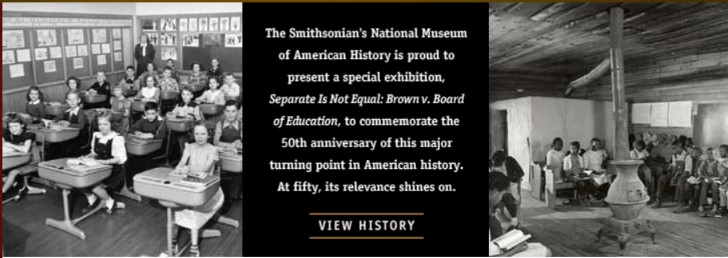
For much of the country’s history, there was a distinct difference between White and Black lives in America. This actuality was stark in every aspect, clearly evident in the disposition of schools. Leading into the 1954 decision of Brown v. Board of Education, this contrast in funding, resources, and legal standing was challenged because of the official “separate but equal” doctrine in the US Constitution.
The schools were separate.
The schools were not equal.
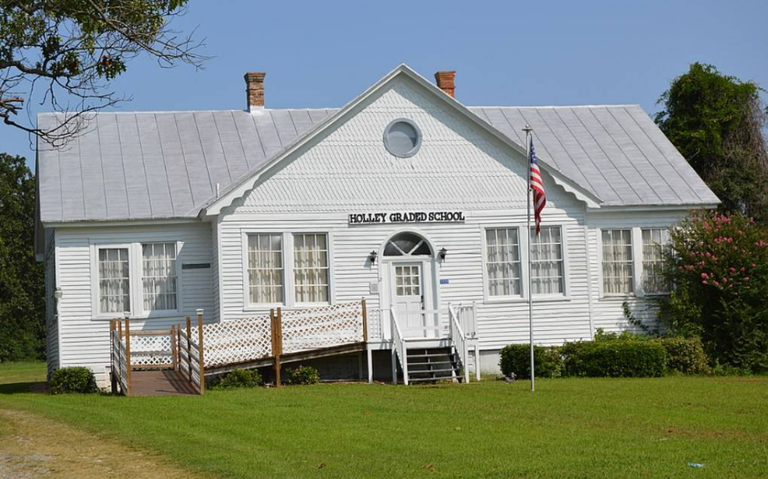
Stand in front of the Holley Graded School in Lottsburg, Virginia (pictured above) and you are looking at the argument.
The little cross-shaped, one-story frame building in Northumberland County holds four identical classrooms, a central passage, two cloakrooms and a kitchen. It was raised in stages between roughly 1914 and 1933, and it taught African American children until 1959. That closing date is the first thing that should unsettle us. Nineteen fifty-nine is not antiquity. There are people still living who walked through that door, and people still living who never had to.
The building was never merely a building. In the segregated South, a schoolhouse was a public ledger written in lumber, and the entries on the two sides of the color line did not match.
The Ledger
Across the former Confederacy, Virginia included, Legislatures and County Boards distributed school money in ways that left Black communities with a fraction of what White Schools received. The disparity was not one line item; it was every line item at once. White Districts built brick consolidated schools with auditoriums, laboratories, libraries, indoor plumbing, and central heat. Black districts got frame buildings on donated land, wood stoves, outdoor privies, and hand-me-down textbooks with another child’s name already inked inside the cover.
Teachers were paid on separate scales, so the Black Teacher with equal or greater training earned less for a longer roster of students. School terms were shorter, often bent around the agricultural calendar, so that Black children could be released to the fields at harvest. Transportation, the quiet decider of who can attend school at all, was routinely provided to white pupils and withheld from Black ones. Children walked past the buses that would not stop for them. Beyond the eighth grade, in County after County on the Northern Neck and throughout rural Virginia, a Black student who wanted High School had to board away from home, travel at family expense, or simply stop.
Even the construction money reveals the arrangement. Many Black schools of this era exist because the community and outside philanthropy paid for them. Families who were already taxed for a public school system they could not fully use raised additional cash, cut and hauled the timber, donated the acre, and fed the carpenters, and then were told the result was a gift. Holley Graded School, built in stages over roughly two decades, carries that story in its very construction schedule: it grew as the people could afford to grow it.
The Contrast, Plainly Stated
Set the two experiences side by side and the picture is stark. One community’s children were educated as a matter of public obligation, funded by the whole tax base, housed in permanent buildings, carried there by public vehicles, and expected to continue through twelve grades. The other community’s children were educated as a matter of their own parents’ sacrifice, in a building the public would not fully fund, on a shortened calendar, on foot, and with the expectation that formal schooling would end early.
It is important to say that this was not neglect. Neglect is inattention. This was a designed system, maintained by budgets, statutes, and School Board minutes, and defended in public. Virginia’s response to “Brown v. Board of Education” made the intention explicit: rather than integrate, the Commonwealth pursued Massive Resistance, and Prince Edward County closed its public schools entirely from 1959 to 1964 rather than teach Black and White children together. Nineteen Fifty-Nine again. The same year Holley’s classrooms went quiet, the State was demonstrating that it would sacrifice public education itself before it would share it.
| Learning Box – Davis v. County School Board of Prince Edward County |
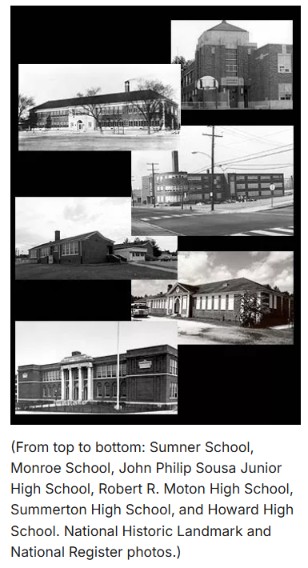
| This was one of the five cases combined into Brown v. Board of Education, the famous case in which the U.S. Supreme Court, in 1954, officially overturned racial segregation in U.S. public schools. The Davis case was the only such case to be initiated by a student protest (on behalf of 117 students[11][12] in which Dorothy Davis was the first plaintiff listed). The case challenged segregation in Prince Edward County, Virginia. Background R.R. Moton High School, an all-black high school in Farmville, Virginia, suffered from terrible conditions due to underfunding. Built in 1939 to hold 180 students, by 1940 it was educating over 450.[1] The school did not have a gymnasium, a cafeteria, or an auditorium with fixed seats, and students and student athletes often re-used old, worn books, equipment, and athletic uniforms handed down from the nearby white school.[2] County officials handled the overcrowding problem not by expanding or rebuilding the school, but by building temporary classroom structures. These were unevenly heated by potbelly stoves, covered by leaky roofs that had the students using umbrellas inside when it rained, and sometimes mistaken for chicken coops by people who didn’t know any different.[2] Teachers and students did not have desks or blackboards, and due to overcrowding, some students had to take classes in an immobilized, decrepit school bus parked outside the main school building. Some classes were held in “three temporary tar-paper shacks” built to house the overflow at the school. It was so cold during the winter that teachers and students had to keep their coats on. The school’s bus was said to be hand-me-down from the white school and was driven by the history teacher.[3] … The case was championed by the NAACP Legal Defense Fund and the students it represented sought a judgement from the court declaring that the system of segregating school students by race was discriminatory to the point of being in violation of the 14th Amendment (Equal Protection) of the US Constitution.[16] |
Do Black Lives Matter? Ask the Budget
The phrase is easy to say now. It is also easy to treat as rhetoric, as if it were only a slogan of the present decade rather than a question that every generation has already answered in the concrete terms of what it was willing to buy for other people’s children.
| Learning Box – Civil Rights Opposition: Where’s the Gratitude? |
| The Civil Rights Movement faced extensive contemporary criticism and skepticism from various political sectors, even as later generations expressed profound gratitude for its historic breakthroughs in equality and justice. Contemporary Criticism o Opposition to Tactics: Critics during the 1950s and 1960s—including segregationist politicians and moderate commentators—frequently condemned civil disobedience, boycotts, and demonstrations as disruptions of public order. o Accusations of Impatience: Mainstream figures often argued that the movement was pushing “too fast, too soon,” claiming legal and social changes should happen gradually rather than through direct-action campaigns. o Federal Intervention Backlash: Opponents criticized federal legislation like the Civil Rights Act of 1964 and the Voting Rights Act of 1965 as federal overreach into states’ rights. Expressions of Gratitude and Reflection o Making Racism Unpopular: As noted by leaders like Carol Moseley Braun, a primary enduring victory of the movement was shifting cultural norms so that overt racism became publicly unpopular. o Expanding Democracy: Figures such as Thurgood Marshall emphasized deep appreciation for the framework of the American constitution while urging citizens to continually protect and expand the rights secured by activists. o Ongoing Commitment: Contemporary evaluations frequently stress that expressing true gratitude for historical sacrifices involves acknowledging remaining systemic challenges and continuing the pursuit of equity. [1, 2] |
A society’s real answer is not in its speeches. It is in its appropriations. When a County decides how much per pupil, which roof gets repaired, whose bus runs, which Teacher gets the salary, how many months the term will last, and how far a child may go before the doors close, it is making a statement about whose future is worth financing. Measured that way, the answer given in Virginia’s Northern Neck for the better part of a century was no, or at best, not equally, and not yet.
Children read that answer. A child who walks four miles past a bus, into a stove-heated room, with a used book bearing another child’s name, has been told something about their standing. That is the deepest cost of the disparity, and the one that does not appear in any budget.
The Counter-Argument the Community Made
And yet the second half of this History is the one that redeems the first. From Reconstruction to 1959, African American families on the Northern Neck pursued education with a determination that outran every obstacle placed in front of it. They understood, with total clarity, that literacy was a form of liberation, and they were unwilling to wait for the State to agree.
Holley Graded School stands as the community’s own answer to the question the County had answered for it.
Where the public purse said one thing, the Church collection, the Lodge Hall, the Sewing Circle, the farmer’s spare Saturday, and the underpaid Teacher who stayed anyway all said the opposite. Those four equal classrooms were built by people asserting, in the only vocabulary the world respects, that their children mattered. That is the Community Ethos the building preserves: the underlying sentiment that shaped the beliefs, customs, and practices of a people who refused to be told the size of their own future.
Why the Currency Matters
Calling this Hidden History risks making it sound distant. It is not. The building closed within the lifetime of people we can still speak to. The families who attended are our neighbors. The wealth that was not built, the High School diplomas not earned, the college educations not financed, the property values shaped by which schools a District maintained: these are not sealed in 1959. They compound. Unequal school funding does not end when the law changes; it ends when the accumulated difference is deliberately repaired.
So the honest use of Holley Graded School is not nostalgia. It is a standard. It asks a plain question of the present, in the same terms the past was judged by: look at what we fund, what we maintain, who we transport, whose Teachers we pay, and how far we let each child go. That is the answer we are giving right now, and like the School Board minutes of 1933, it will be legible to anyone who cares to read it later.
This little white cross-shaped building in Lottsburg is not asking to be admired. It is asking to be answered.
😐
Do Black Lives Matter?
We asked the question:
Did Black Lives Matter back then? Looking at the budget and priority for schools, the answer was self-evident!
Do Black Lives Matter now?
Ask/Say that too loud and the local White Community pushes back!
They accuse the African-American community of being ungrateful.
Further, they even go as far of accusing the BLM Movement of being a Domestic Terror Organization.
🙁
What does the record show?
| Learning Box – Is Black Lives Matter (BLM) movement a Domestic Terrorist Organization |
| The U.S. federal government does not officially designate the Black Lives Matter (BLM) movement as a domestic terrorist organization. [1, 2] Government and Legal Stance o No Domestic Designation Regime: According to the American Civil Liberties Union (ACLU) and federal clarifications, the United States government does not maintain a legal mechanism or official list for labeling domestic groups as terrorist organizations, unlike foreign entities. [1, 2]] o Petitions and Responses: When a formal “We the People” petition in 2016 requested that the federal government designate BLM as a terror group, the Obama White House responded that the administration plays no role in such domestic designations and that the request was unaddressable. [1, 3] Perspectives and Public Debate o Criticism and Rhetorical Labels: Opponents and certain law enforcement figures—such as former Minneapolis Police Union head Bob Kroll—have rhetorically applied the label of domestic terrorism to describe instances of arson, property damage, and clashes with police during some 2020 protests. [4, 5] o Civil Rights and Advocacy Defense: Civil rights organizations and advocacy groups, including Color of Change, explicitly state that Black Lives Matter is a nonviolent social justice movement focused on racial equality and accountability, rather than a terrorist organization. [6, 7] |