 rosawyer
Here still … lies a “gifted” schoolhouse in the Northern Neck that taught more than the ABC’s and 123’s. It taught a community how to dream-a-dream, talk-the-talk and walk-the-walk … for them and their children.
The Woman Behind the Gift
Emily Howland was born into a Quaker family in Sherwood, New York, in the Abolitionist heart of Cayuga County. Quaker conviction gave her both a moral compass and an unusual freedom: she was a woman of independent means who never married, and she spent nearly a century turning that independence into schools. Before the Civil War she taught at Myrtilla Miner’s school for free Black girls in Washington, D.C. During the war she worked among refugees from slavery in the camps around the capital, where she saw firsthand what emancipation without education would mean. Afterward she made the education of freed-people her life’s work, funding, founding, or supporting dozens of schools across the South. The Howland Chapel School in Virginia’s Northern Neck is one of the most intact survivors of that campaign.
| Learner’s Box – Emily Howland |
Emily Howland (November 20, 1827 – June 29, 1929) was a philanthropist, humanitarian, and educator. She supported the education of African-Americans. She was also a strong supporter of women’s rights and the temperance movement. Howland personally financed the education of many black students and contributed to institutions such as the Tuskegee Institute,[1] Henry Damon Davidson‘s Centerville Industrial Institute,[2] and Kowaliga Institute in Kowaliga, Alabama, where Howland Hall was named for her.[3] 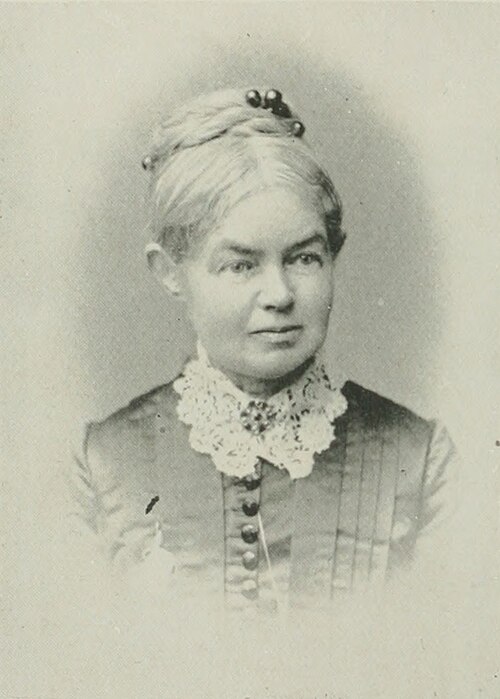 Talk-the-talk & Walk-the-walk An active abolitionist, Howland taught at Normal School for Colored Girls (later known as the Miner School and now University of the District of Columbia) in Washington, D.C., from 1857 to 1859. During the Civil War, she worked at the contraband refugee settlement of Camp Todd in Arlington, Virginia, establishing a school where she taught freed slaves to read and write as well as administering to the sick during a smallpox outbreak, coordinating relief efforts, and ultimately serving as director of the camp from 1864 to 1866.[6][7] Beginning in 1867, she started a community for freed people in Heathsville, Northumberland County, Virginia, called Arcadia, on 400 acres purchased by her father, including a school for the education of children of freed slaves, the Howland Chapel School.[8][5] She continued to maintain an active interest in African-American education, donating money and materials as well as visiting and corresponding with administrators at many schools.[5] Returning to Sherwood, New York, after her father’s death in 1881, she inherited $50,000 ($1.67 million in 2025 dollars) and ran the Sherwood Select School until 1926 when it became a public school and was renamed the Emily Howland Elementary School by the state of New York.[5] |
Reconstruction in the Northern Neck
The Northern Neck — the peninsula between the Potomac and the Rappahannock — had been tobacco-and-plantation country, and in 1865 its African American majority in many neighborhoods emerged from slavery with no legal claim to schooling. Virginia had no public school system until 1870, and where schools for Black children did appear they were built by the freed-people themselves, by Northern missionary societies, by the Freedmen’s Bureau, and by private benefactors. Buildings had to be paid for, teachers had to be paid, and both had to be defended against local hostility. Philanthropy of Howland’s kind was not charity at the margins; it was often the only means by which a rural Black community could get a schoolhouse at all.
The Founding of the School, 1867
In 1867, near Heathsville in Northumberland County, Howland’s money built a one-story frame schoolhouse for the children of former slaves. Its official name was the First Baptist Howland Chapel School — a name that identifies its allies as much as its benefactor. The qualifier “First” was not decorative. American Baptists had split in the run-up to the Civil War, and the Southern Baptist Convention had organized itself in defense of slaveholding, while the Northern (“First Baptist”) wing stood with the Abolition movement. The school was the work of that Northern contingent, joined to Howland’s Quaker purse and to a local Black congregation determined to have a school. The denominational fracture that gave the school its name was not formally addressed by the Southern Baptist Convention until 1995, when it adopted a resolution renouncing its racist roots and apologizing for its past defense of slavery, segregation, and white supremacy — its first formal acknowledgment that racism had shaped both its founding and its modern life.
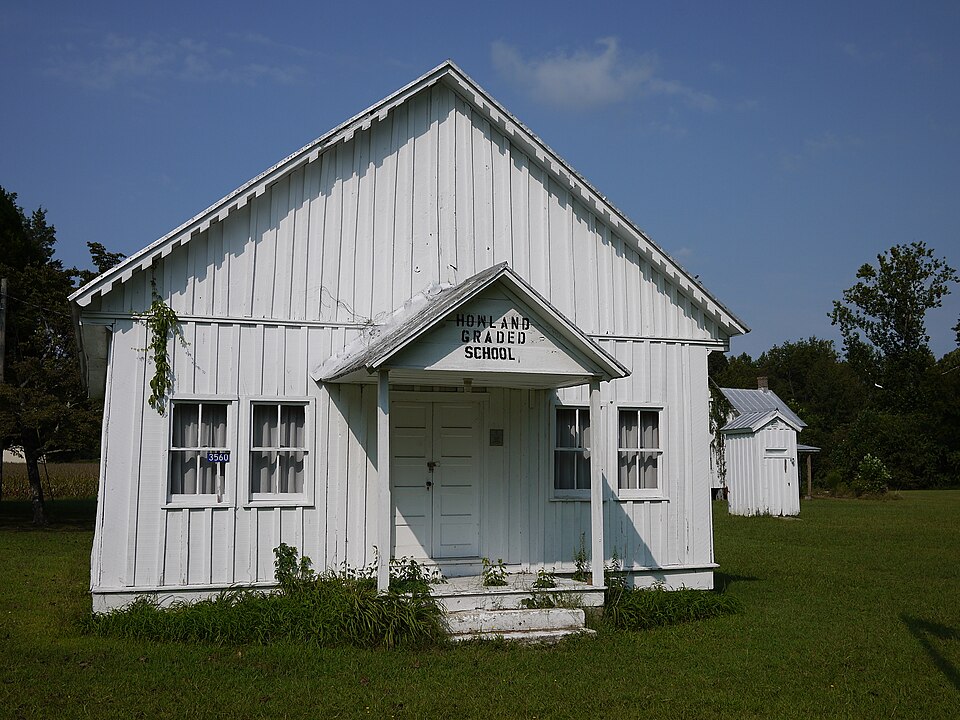
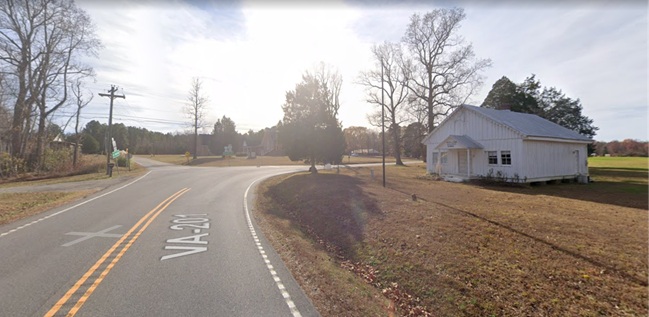
The building here, itself still tells the story of the care taken with it. It is modest in scale but not plain: board-and-batten siding, decorative bargeboards, dentil soffits under the eaves. Nobody spends money on dentil soffits for a building they consider temporary. The craftsmanship is an argument — that Black children’s education deserved a permanent, dignified, well-made house.
| Learner’s Box – First Baptist and Black Education |
| First Baptist churches played a vital role in early Black education by founding some of the earliest schools for African Americans in the United States. [1, 2] Early Schools and Leadership o Pioneering Institutions: Historic congregations like the First Baptist Church in Petersburg, Virginia, established schools for Black children shortly after their founding. These are often cited as the oldest educational institutions specifically created for Black Americans. [1, 2] o Independent Beginnings: Early Black congregations and independent Black Baptist churches prioritized literacy so congregants could read scripture and lead their communities. [1, 2, 3] o Legislative Backlash: Following events like the Nat Turner slave rebellion in 1831, white lawmakers grew fearful of independent Black religious and educational gatherings. By 1832, legislation forced many Black churches to accept white pastors to suppress perceived threats of revolt and control the delivery of messages. [1, 2] Post-Emancipation and Higher Education o Reclaiming Control: After the Civil War, Black congregations regained autonomy over their pulpits and immediately expanded educational and community outreach. [1, 2] o Founding Colleges: Denominational efforts by Baptists and other religious groups laid the groundwork for more than 200 Historically Black Colleges and Universities (HBCUs), often starting classes in church basements. For example, leaders from the First African Baptist Church in Savannah, Georgia, helped establish institutions like Savannah State University, Morehouse College, and Paine College. [1, 2] |
What the School Became
Howland Chapel School served the community as a school until 1958 — ninety-one years, spanning Reconstruction, the imposition of Jim Crow, two world wars, and the beginning of the end of legal segregation. Generations of Northumberland County families learned to read in the same room. When it finally closed as a school, it was not abandoned: the building continued as a museum, a community center, and a site of adult education, and it was listed on the National Register of Historic Places in 1991. Few buildings in the Northern Neck have been continuously useful to one community for so long.
See the building here, on State Road 201:
Reading the Record Honestly
The point of remembering Emily Howland is not to make her a Saint standing above the people she funded. The teachers, congregations, and parents of Northumberland County built the school’s actual life; a Northern donor supplied the means, and Northern churches supplied the network. Nor is the point to indict the families and institutions that opposed such schools. The Northern Neck of the 1860s was the ground on which both heroes and villains stood, and the work of history is to call balls and strikes correctly — to say plainly who paid for the schoolhouse, who taught in it, who tried to keep it from being built, and who eventually apologized.
Measured that way, Howland’s contribution cannot be understated. She never lived in the Northern Neck. She lived to be 101, kept giving to Black schools for six decades, and left behind, in a small Virginia county, a board-and-batten building that outlasted segregation itself. That is what philanthropy looks like when it is aimed at literacy rather than at monuments — and, as it happens, the building became the monument anyway.